Eight tips for writing a successful press release
When I worked in a newsroom, I spent a chunk of my time sifting through the hundreds of press releases that filled my inbox. I was the journalist who chose which press release was worth covering as a story or investigating further. Now I write press releases to pitch and send to journalists, who will then decide whether to cover my client’s story. I’m pleased to report my success rate has been pretty good.
My background as a journalist means I have an insight into how to write a successful press release. Here are my top 8 tips.
1. Make sure you have a story.
A press release is not an advert. A journalist will bin any press release which reads as advertising. Journalists are looking for stories, not adverts.
Here are some of the types of stories a journalist finds interesting:
· Human interest — have you launched a new product or service? Use a case study to show how it’s making a difference to people’s lives or tell the story of the person behind its success.
· Company news — have you made a new appointment, are you expanding your staff, opening a new office, announcing a merger, holding an event?
· The good work you are doing in your corporate social responsibility role.
2. Write a catchy headline.
Your press release needs to capture the journalist’s attention, and the first thing they will read is the headline. You want your headline to entice them to read on, not encourage them to consign it to the trash bin. Keep it clear, simple, short, and engaging. It should convey what your press release has to say in one line. I’ve always preferred to send and receive press releases by email. You’ll also need to think about the subject line for your email. The journalist won’t see the headline you’ve crafted if you haven’t persuaded them to open your email.
3. Ensure your press release is well written.
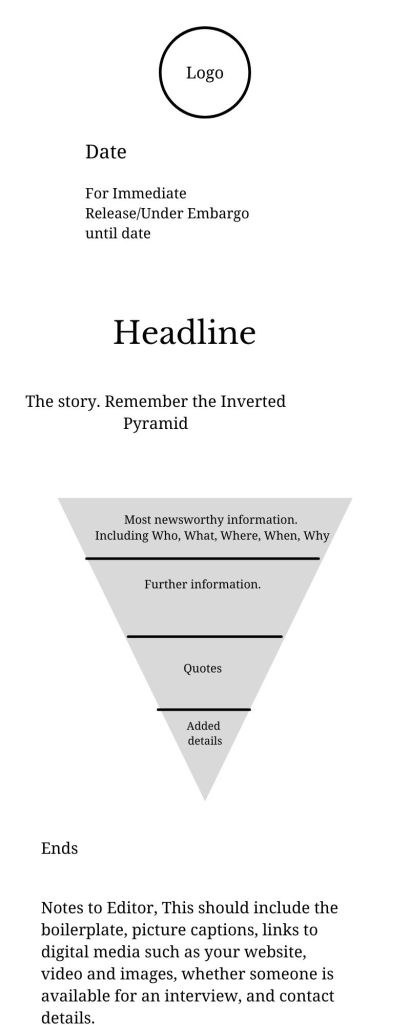
If your press release is full of grammatical and spelling errors or too difficult to read, the journalist is less likely to use it. When you write your press release, structure it to tell the most newsworthy details first. Extra information should follow in order of importance. Journalists and copywriters use the inverted pyramid structure to achieve this. Your press release should also answer the questions who, what, when, where, and (if relevant) how. Your sentences should be simple and easy to read, written in plain English and avoid jargon. To achieve this aim for a Flesch-Kincaid reading ease score in the 60s —this is a reading age of 12 – 15.
4. Include a photograph or other image.
You should always send a photograph or other image with your press releases. In fact, I won’t send out a press release without one. This is because stories with images perform better. Newspapers and magazines are full of photographs, and images are vital for online content. Social media posts with images perform better, and pictures improve the ranking of website pages.
As well as photographs, you could provide a video or infographic. You can send pictures as an attachment or provide a link where the journalist can access your images or other helpful content.
5. Use good quotes.
A press release should always include quotes. They can add human interest, provide insight, and give more information. Your quote should be from a person involved in your story, and it should add some extra information.
6. Target the correct journalist for your story.
I was a journalist in the North East and found it frustrating when I received press releases highlighting figures for the North West. Make sure you send your press release to the right journalist at the correct outlet. You should send a business story to a reporter on the business desk and not news. If your press release is about environmental issues, send it to a reporter interested in that subject. And check your geography. For instance, there are 13 places called Barton in England. Which one do you want to target?
7. Added extras.
Every press release needs Notes to the Editor after the ending.
This section should include:
· A boilerplate – this is your chance to advertise your company by providing two or three sentences summarising your company’s mission and history.
· Contact details of who is handling enquiries from the media. If the journalist needs more information, who do they contact and how.
· Picture captions – if you have sent a photograph (and I hope you do), you need to list from left to right who is in the picture and their job title if relevant.
· Links to images and other useful content, including your website.
· A line telling the journalist that someone is available for interviews, photographs, filming etc.
8. Layout.
As a journalist and copywriter, I can write and pitch your press release to the media. For more about the world of writing, check out my Facebook and Instagram. Drop me an email at joanna@joannawoodhouse.co.uk.
 Joanna Woodhouse, Writer and Copywriter