Tag: Journalism

  • How to write a press release that gets noticed by journalists.

    Eight tips for writing a successful press release

    When I worked in a newsroom, I spent a chunk of my time sifting through the hundreds of press releases that filled my inbox. I was the journalist who chose which press release was worth covering as a story or investigating further. Now I write press releases to pitch and send to journalists, who will then decide whether to cover my client’s story. I’m pleased to report my success rate has been pretty good.

    My background as a journalist means I have an insight into how to write a successful press release. Here are my top 8 tips.

    1. Make sure you have a story.

    A press release is not an advert. A journalist will bin any press release which reads as advertising. Journalists are looking for stories, not adverts. 

    Here are some of the types of stories a journalist finds interesting:

    · Human interest — have you launched a new product or service? Use a case study to show how it’s making a difference to people’s lives or tell the story of the person behind its success.

    · Company news — have you made a new appointment, are you expanding your staff, opening a new office, announcing a merger, holding an event?

    · The good work you are doing in your corporate social responsibility role.

    2. Write a catchy headline.

    Your press release needs to capture the journalist’s attention, and the first thing they will read is the headline. You want your headline to entice them to read on, not encourage them to consign it to the trash bin. Keep it clear, simple, short, and engaging. It should convey what your press release has to say in one line. I’ve always preferred to send and receive press releases by email. You’ll also need to think about the subject line for your email. The journalist won’t see the headline you’ve crafted if you haven’t persuaded them to open your email. 

    3. Ensure your press release is well written.

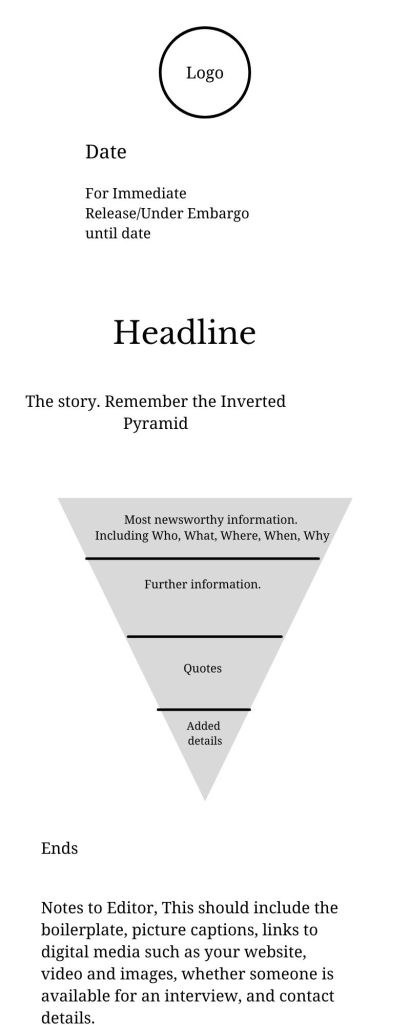
    If your press release is full of grammatical and spelling errors or too difficult to read, the journalist is less likely to use it. When you write your press release, structure it to tell the most newsworthy details first. Extra information should follow in order of importance. Journalists and copywriters use the inverted pyramid structure to achieve this. Your press release should also answer the questions who, what, when, where, and (if relevant) how. Your sentences should be simple and easy to read, written in plain English and avoid jargon. To achieve this aim for a Flesch-Kincaid reading ease score in the 60s —this is a reading age of 12 – 15.

    4. Include a photograph or other image.

    You should always send a photograph or other image with your press releases. In fact, I won’t send out a press release without one. This is because stories with images perform better. Newspapers and magazines are full of photographs, and images are vital for online content. Social media posts with images perform better, and pictures improve the ranking of website pages. 

    As well as photographs, you could provide a video or infographic. You can send pictures as an attachment or provide a link where the journalist can access your images or other helpful content.

    5. Use good quotes.

    A press release should always include quotes. They can add human interest, provide insight, and give more information. Your quote should be from a person involved in your story, and it should add some extra information. 

    6. Target the correct journalist for your story.

    I was a journalist in the North East and found it frustrating when I received press releases highlighting figures for the North West. Make sure you send your press release to the right journalist at the correct outlet. You should send a business story to a reporter on the business desk and not news. If your press release is about environmental issues, send it to a reporter interested in that subject. And check your geography. For instance, there are 13 places called Barton in England. Which one do you want to target? 

    7. Added extras.

    Every press release needs Notes to the Editor after the ending. 

    This section should include:

    · A boilerplate – this is your chance to advertise your company by providing two or three sentences summarising your company’s mission and history.

    · Contact details of who is handling enquiries from the media. If the journalist needs more information, who do they contact and how.

    · Picture captions – if you have sent a photograph (and I hope you do), you need to list from left to right who is in the picture and their job title if relevant.

    · Links to images and other useful content, including your website.

    · A line telling the journalist that someone is available for interviews, photographs, filming etc.

    8. Layout.
    As a journalist and copywriter, I can write and pitch your press release to the media. For more about the world of writing, check out my Facebook and Instagram. Drop me an email at joanna@joannawoodhouse.co.uk. 
  • What qualities can a journalist bring to copywriting?

    6 Skills that make journalists effective copywriters

    When I decided to make the switch from the bustling newsroom to the world of freelance copywriting I questioned if I had the skills to do it. After all journalism and copywriting are two different disciplines. A journalist investigates and writes news and more in-depth features.  A copywriter writes to persuade a reader to take an action — whether that’s to click, make a sale, or book an appointment. But as I learnt more about the disciplines of copy and content writing I found many of my journalism skills were a good fit. And they’ve shaped the copywriting service I offer to my clients.

    What skills can a journalist bring to copywriting?

    Every news story or feature starts off with research. At the heart of every story is the interview. By asking lots of questions a journalist to tell the story will find the right angle to make the story interesting or relevant, and get insightful quotes, and provide the face to the story. I ask my clients lots of questions to ensure I get the information needed to write the content that will get them results.

    Journalists also break and back up stories by sifting through figures, reading annual reports, researching using search engines and social media, and much more. This skill can be put to good use in copywriting to get to know your business and industry, your competitors, and to understand your customers and their motivation.

    Journalists need to be able to quickly gain knowledge on topics which are new to them and turn complex subjects and jargon into writing which is easy for the reader to understand. This skill gives them an edge in producing copywriting which is engaging throughout.

    Throughout time humans have been captivated by stories, and storytelling is a powerful tool to capture your customer’s interest, engage them and help them build a connection with your brand.

    At the heart of journalism is the ability to write a good story which hooks the reader. This is a skill a journalist turned copywriter will put to good use to make your content stand out.

    To write a strong news story a journalist will pick the strongest angle, use powerful quotes, include facts and statistics, and feature human stories as case studies. They will then structure the story in a way which captures the reader’s attention and encourages them to continue reading the story.

    When it comes to producing your content, a journalist turned copywriter can put their storytelling skills to good use. Case studies, social media posts, website content, press releases, advertorials, blog posts, direct sales letters, email marketing, and newsletters are all forms of copywriting where storytelling can be effective.

    During my newsroom days I loved the rush of meeting a deadline. Among the ones I looked forward to most were A-level and GCSE results days. These days took organisation to ensure I had all the information I needed for our 9am deadline. Schools and press officers were prepped and primed for the event, and venues for photographs of happy students were set up before the summer holidays.

    Deadlines are a daily pressure for journalists. Organisation, time management, and quick-thinking, and even faster typing are key to meeting them. And these skills are vital when it comes to meeting the deadline of a copywriting project. If you have a tight deadline to meet a journalist turned copywriter will be able to work quickly to meet it.

    Every piece of work a journalist produces is pored over by editors. They criticise, ask questions, and expect rewrites to be done quickly. So, when you ask your copywriter to make changes to your copy, you can feel safe in the knowledge that after years of editors’ comments, they won’t take it personally, and they will act on it. And I know that the changes you need will mean you get the copy you want.

    KISS (Keep it Short and Simple or Keep it Short and Sweet) is one of the many acronyms in the world of marketing. The principle is that short and easy to read copy is easier to read and more likely to grab and hold the reader’s attention. Writing short and simple copy is something journalists learn in training. They use short sentences, simple words, and structure the story, so the reader finds it easy to read and doesn’t lose interest. Time and space are also reasons journalists need to learn how to keep reports short without losing impact. A reporter will learn how to edit their work to fill a space on a page or a few minutes of airtime, and still tell the story.

    Long words, jargon, lengthy sentences, and copy that doesn’t get to the point quickly will bore your reader. And the same principle applies to copywriting. By keeping it short and simple your sales copy will capture and hold the reader’s attention, which gives you a better chance of persuading them to take an action. A journalist turned copywriter has lots of experience in how to Keep it Short and Sweet.

    News stories must be well-balanced, objective, and backed up by facts. By producing honest copy and accurate copy with statistics and case studies, you will create trust with your reader. That trust means your copy is more likely to convert.

    Articles also need to be free from errors grammatical and spelling errors, names and numbers need to be correct. This means a journalist spends time proof reading and double-checking what they have written. And they will do the same for your copy.

  • My journey from journalist to copywriter.

    I decided to become a Freelance Copywriter after an advert caught my eye. It was to write for a training provider. After several years working as the education specialist on a local newspaper, I thought it would be ideal. But the company wasn’t looking for a journalist, it wanted a copywriter. And my application bombed.

    The idea of working freelance and being my own boss stayed with me though. And copywriting interested me.

    Journalism had attracted me because, with thorough research and powerful writing, an article can be a force for change. Effective copywriter can also be powerful. Persuasive web copy can help a start-up to build a successful business. A college prospectus can entice a student to sign up for a course that can change their life. And with powerful copy, a charity can attract new volunteers and donations.

    I was excited about how I could use my writing skills to help businesses and charities to achieve their goals. But to add copywriting to my writing skillset there were a few steps that would help me out. And in this post, I’m sharing the path I’ve taken so far.

    Become a certified copywriter.

    Signing up for a course has given me confidence in my abilities as a copywriter. After researching online courses, I chose the College of Media and Publishing’s Copywriting course. The course gives you the chance to learn and practice different types of copywriting, ranging from Direct Mail to Social Media posts. The content and tutor support are excellent. I already knew about readability and press release creation. But I know much more now. And after spending hours poring over the details of the ASA’s Code of Practice, it’s engraved in my brain.

    Read lots of helpful books.

    Reading helps your writing to improve. And I love reading, both fiction and non-fiction. I have also developed an addiction to books written by top copywriters. These books have taught me a lot about the process of copywriting and selling.

    My recommendations to date are:

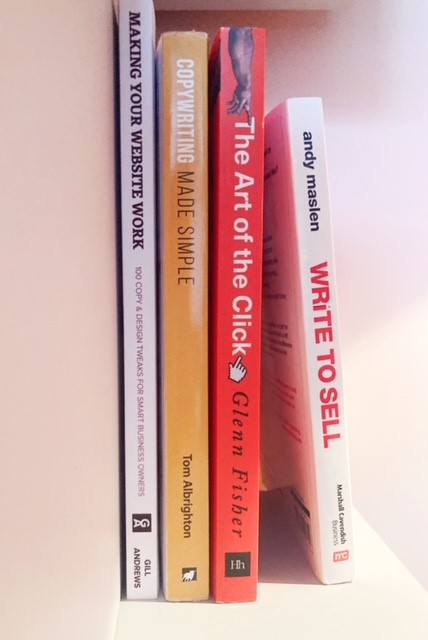
    • ‘Write to Sell’ by Andy Maslen
    • ‘Copywriting Made Simple’ by Tom Albrighton
    • ‘How to Write Seductive Web Copy’ by Henneke Duistermann.
    • Making your website work by Gill Andrews.

    And on my ‘to be read’ pile is ‘The Art of the Click’ by Glenn Fisher.

    Books I recommend for learning about copywriting.

    Join a professional organisation.

    One of the first things I did when I decided to go freelance was join ProCopywriters. It provides opportunities for copywriters to:

    • Learn and develop through webinars, blogs posts and conferences.
    • Gives them the opportunity to showcase their work.
    • Helps members find work.
    • Post their profile on a database of writers.

    Learn from other copywriters.

    There are many copywriters to learn from. I’m grateful to learn from copywriters who:

    • Run successful mentoring programmes.
    • Host helpful Facebook groups.
    • Email out handy and entertaining newsletters.
    • Write thought-provoking blog posts and social media content.

    The steps I have taken to date have helped shape me to be the writer I am today. But you can never stop learning, which means this journey has not ended, and my development will go on.

    Do journalism and copywriting have anything in common?

    Journalists and copywriters use the written word for different purposes. I’m proud to be both a journalist and a copywriter. And it means I can offer my clients a broad range of writing services. Can the qualities of a journalist complement that of a copywriter? Watch out for a future blog post when I’ll discuss that.

    This journey has reinforced how much I love research and writing. Whether it’s an article, a piece of sales copy, or this blog post. And I’m lucky to be able to offer my services doing what I love. To find out how my writing can help your organisation drop me an email at joanna@joannawoodhouse.co.uk.