Recently I stepped away from the protection of my computer screen to present a seminar to a room of businesspeople. The topic was copywriting and how effective copywriting can help businesses. One point which sparked interest was how we can check how easy our writing is to read. Writing easy-to-read engaging copy is a subject that interests me, and I am always keen to learn more.
Why do I find this interesting? Because if our copywriting is hard to read, it won’t be read, and then it will fail to get the results we want.
Here are five tips to help you craft words that are both easy to read and engaging.
1. Writing for the majority
During the 19th and 20th centuries, research was conducted to help develop writing that most people could easily understand. Researchers are investigating how best we can write words for a screen today.
Readability formulas developed in the U.S.A. in the 20th century continue to help us write words that can be understood by the wider population today. These include Flesch Reading Ease, Gunning Fog Index, and Flesch-Kincaid Grade Level.
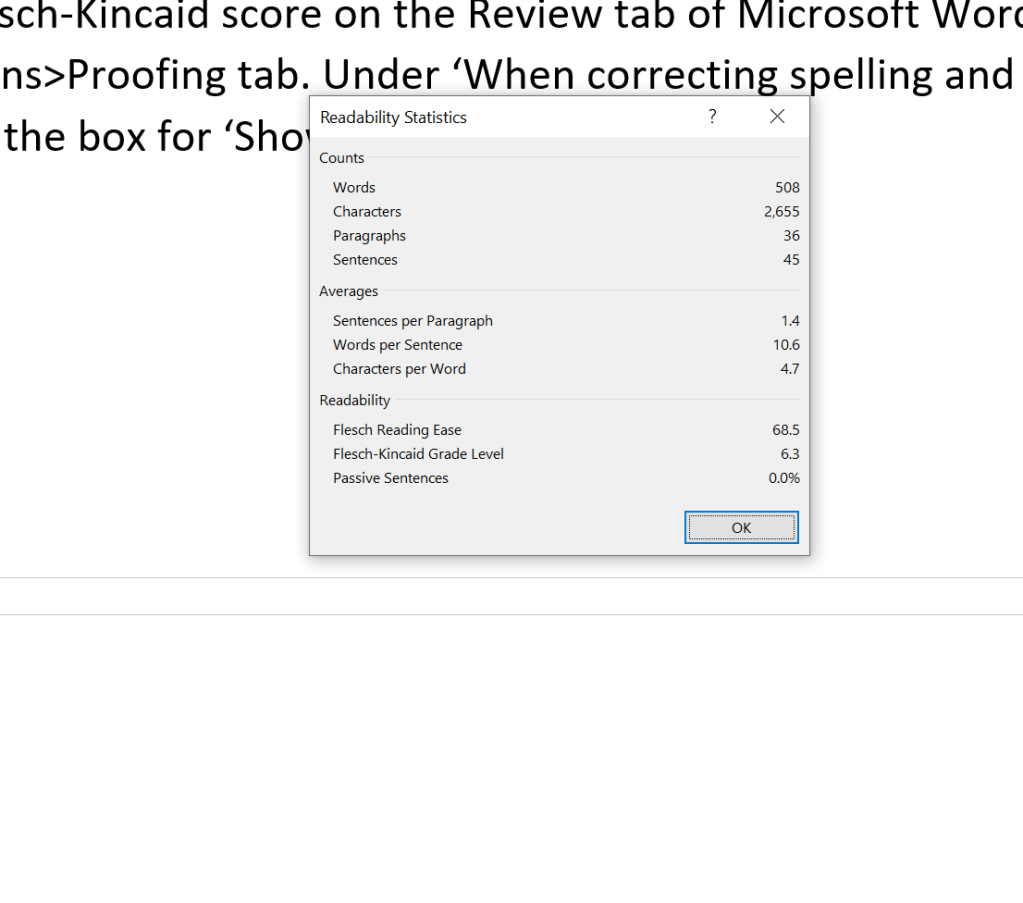
If you get a Flesch Reading Ease score in the 60s, you are writing in plain English. To be understood by most readers, your copywriting should get a Flesch-Kincaid Grade level of 8 or lower. Grade 8 is 13-14 years old. I aim for a reading age of 12, which is grade 7.
If you use Microsoft Word, you can find out your Flesch Reading Score and Flesch-Kincaid Score. To do this, go to editor, on the review tab and click document stats.
How can you achieve these scores?
Flesch calculated his formula using sentence and word length. So, we need to use shorter sentences and simpler words. Shorter sentences are easier to read and work better on smaller screens. Try to vary your sentence length. If all your sentences have a similar short word count, they can become dull to read or too staccato. It’s time to kill your darlings if you aren’t hitting the ideal readability scores. Could you cut some sentences in two or delete words without losing meaning?
Remember K.I.S.S, which means keep it short and simple, or keep it simple, stupid. Avoid jargon, choose easy-to-understand words, shorter sentences, and punchy paragraphs.
2. Write in the active voice
Writing in the active voice is more engaging and easier to read than passive voice. A quick grammar lesson: In the active voice, the subject of the sentence does the action to the object; in the passive voice, the action is done by the subject. Here are some examples:
Active: Ben played the drums.
Passive: The drums were played by Ben.
Active: Barney scored the winning goal.
Passive: The winning goal was scored by Barney.
Active: The company tripled its sales in 2023.
Passive: In 2023, the sales of the company were tripled.
The active voice is more direct and makes more impact than the passive voice. Ideally, you should always try to write using the active voice. However, there may be instances when you need to use the passive voice if it is clearer to understand.
3. Write like a journalist
Journalists and copywriters both write for a wide audience, so it’s not a surprise that there are some practices they share. One of which is the inverted triangle technique. and is one of the ways copywriters can engage their readers.
Using the inverted triangle means we tell the reader the most important details they need to know first. These are the details which will capture the reader’s attention, and it’s one technique copywriters can use to write engaging and persuasive copy. One example could be revealing in the first sentence how your product or service will help your ideal customer.
Capturing our reader’s attention is the first step of the copywriting technique A.I.D.A., which stands for Attention, Interest, Desire, and Action. Once we have their attention, we can hold their interest, create that feeling of need or want and entice them to take that call to action.

4. More you can ways to hook your reader
You can tempt a reader to engage with your copy in many ways. The inverted triangle is one of them. You could also hook or capture their interest with a question identifying a problem they need to solve. Or an interesting statistic that helps sell your service. One of my favourites is telling a story. Stories can be memorable and emotive, provide human interest and are a powerful way of drawing the reader in.
5. Write for the reader
It’s important to remember your copy is not about you. It’s about what you can do for your reader, who is your ideal customer. As well as showing how you can solve their problem and writing in a style that is easy to understand, you need to use their language. By writing using the reader’s language, we can build a relationship with them, provide words they can identify with and get our message across more easily.
6. Break up your text
If you are marketing online, paying attention to how people read on a screen is important. Research by the Nielsen Norman Group has found that people scan when they read online. The tips already covered will help engage a reader who is scanning your words. We can also help them read our words by how we format our text. We can begin with an eye-catching headline, break our text into shorter paragraphs, use sub-headings, bulleted lists, and bold type.
As a copywriter and journalist, I provide writing services for small businesses, agencies, and publications. I can also help you improve your copywriting. If you would like help to ensure your words are engaging, easy-to-read writing or to find out more about my services, get in touch at joanna@joannawoodhouse.co.uk
 Joanna Woodhouse, Writer and Copywriter