Tag: Copywriting

  • Why you should read more to become a Better Writer

    As a schoolgirl, I was an aspiring writer, so when my English teacher said reading was the best way to become a good writer, I paid attention and read more. It wasn’t a hardship because I enjoyed reading and have remained an avid reader. I have discovered many benefits to reading, including for education and wellbeing. As a writer, I agree with my teacher; the most significant benefit is its positive impact on my writing skills. Whether you choose a classic, the latest best-seller, non-fiction, graphic novel, blog, magazine or newspaper, I promise you will reap the rewards from reading.

    These are five ways reading helps you to become a more effective writer.

    Immersing yourself in the prose of the greatest writers can only positively affect how we write ourselves – even if we may never reach their level of skill. You don’t have to read the classics to become a better writer or read books associated with work or study. However, whatever you read should be well-written. As you read, you will absorb the vocabulary, grammar, sentence structure, description, and techniques such as metaphors and personification (even if you are unsure what they are) and incorporate this into your writing.

    There’s a wealth of information exploring the relationship between reading and writing. Both Writing Forward and Writer’s Edit explain in greater detail why you should read to write more effectively, and Readable looks at how reading can improve your writing skills.

    Empathy is invaluable for a copywriter because it helps us to connect with our audience’s motivations. Schools encourage children to read because it improves their reading and writing and helps them develop empathy. With empathy, we can recognise and understand how others feel, see the world through the eyes of others, and recognise each other’s differences – all of which are essential for a successful writer.

    There has been research into how reading helps us develop empathy. The Book Trust has published many articles on how reading helps children develop empathy and why that is important. This article discusses how non-fiction can help children build empathy, and the Book Trust explains why creating empathy through books is so important.

    When writer’s block strikes, reading is one solution I turn to. I may find inspiration from reading about the topic I am writing on. Reading can prompt a clever turn of phrase. The chance to escape into a different world for a few minutes can also be the perfect remedy to get the writer’s brain working again. 

    I read books to help me become a better copywriter, writer, and marketer. There’s a wealth of knowledge in print which goes back hundreds of years, as well as a growing amount online. There’s bound to be something to read on any subject you need to write about. I also read books on other topics I am interested in or wish to learn more about. Some people learn best by watching or listening, while others, like me, prefer reading. I often understand the subject and retain knowledge better when I read it. When I want to check a fact or process, I find it easier to use an index, turn back a page, or scroll up the screen than to rewind a video or podcast. Books can provide more in-depth knowledge on a subject than watching a 20-minute video. Reading also means I don’t have to wear earphones or worry about disturbing anyone with the sound from my device.   

    I enjoy reading for pleasure as well as to improve my knowledge. Books can provide that perfect escape we all need, particularly at the end of a busy day or stressful time. For about half an hour each day, my book transports me away from my life as a mum and freelancer and into the world of my book. Over the past 12 months, I have read about the life of Jane Austen, women in Tudor England, a 1960s US television studio, and the battlefields of the First World War, among others. Wherever my book takes and teaches me, I welcome my daily escape. It provides me with a break from the daily stresses and pressures of life, and I’m thankful I was not a Tudor woman and grateful to the soldiers of the First World War. While escaping into my book, I am improving my writing skills, developing empathy, gaining inspiration and boosting my knowledge.

  • Six tips for easy-to-read, engaging copywriting that gets results

    Recently I stepped away from the protection of my computer screen to present a seminar to a room of businesspeople. The topic was copywriting and how effective copywriting can help businesses. One point which sparked interest was how we can check how easy our writing is to read. Writing easy-to-read engaging copy is a subject that interests me, and I am always keen to learn more.

    Why do I find this interesting? Because if our copywriting is hard to read, it won’t be read, and then it will fail to get the results we want.

    Here are five tips to help you craft words that are both easy to read and engaging.

    During the 19th and 20th centuries, research was conducted to help develop writing that most people could easily understand. Researchers are investigating how best we can write words for a screen today.

    Readability formulas developed in the U.S.A. in the 20th century continue to help us write words that can be understood by the wider population today. These include Flesch Reading Ease, Gunning Fog Index, and Flesch-Kincaid Grade Level.

    Rudolph Flesch developed Flesch Reading Ease in the 1940s. The US Navy later came up with the Flesch-Kincaid Grade Level.

    If you get a Flesch Reading Ease score in the 60s, you are writing in plain English. To be understood by most readers, your copywriting should get a Flesch-Kincaid Grade level of 8 or lower. Grade 8 is 13-14 years old. I aim for a reading age of 12, which is grade 7.

    If you use Microsoft Word, you can find out your Flesch Reading Score and Flesch-Kincaid Score. To do this, go to editor, on the review tab and click document stats.

    Flesch calculated his formula using sentence and word length. So, we need to use shorter sentences and simpler words. Shorter sentences are easier to read and work better on smaller screens. Try to vary your sentence length. If all your sentences have a similar short word count, they can become dull to read or too staccato. It’s time to kill your darlings if you aren’t hitting the ideal readability scores. Could you cut some sentences in two or delete words without losing meaning?

    Remember K.I.S.S, which means keep it short and simple, or keep it simple, stupid. Avoid jargon, choose easy-to-understand words, shorter sentences, and punchy paragraphs.

    Writing in the active voice is more engaging and easier to read than passive voice. A quick grammar lesson: In the active voice, the subject of the sentence does the action to the object; in the passive voice, the action is done by the subject. Here are some examples:

     Active: Ben played the drums.

    Active: Barney scored the winning goal.

    Passive: The winning goal was scored by Barney.

    Active: The company tripled its sales in 2023.

    Passive: In 2023, the sales of the company were tripled.

    The active voice is more direct and makes more impact than the passive voice. Ideally, you should always try to write using the active voice. However, there may be instances when you need to use the passive voice if it is clearer to understand.

    Journalists and copywriters both write for a wide audience, so it’s not a surprise that there are some practices they share. One of which is the inverted triangle technique. and is one of the ways copywriters can engage their readers.

    Using the inverted triangle means we tell the reader the most important details they need to know first. These are the details which will capture the reader’s attention, and it’s one technique copywriters can use to write engaging and persuasive copy. One example could be revealing in the first sentence how your product or service will help your ideal customer.

    Capturing our reader’s attention is the first step of the copywriting technique A.I.D.A., which stands for Attention, Interest, Desire, and Action. Once we have their attention, we can hold their interest, create that feeling of need or want and entice them to take that call to action.

    You can tempt a reader to engage with your copy in many ways. The inverted triangle is one of them. You could also hook or capture their interest with a question identifying a problem they need to solve. Or an interesting statistic that helps sell your service. One of my favourites is telling a story. Stories can be memorable and emotive, provide human interest and are a powerful way of drawing the reader in.

    It’s important to remember your copy is not about you. It’s about what you can do for your reader, who is your ideal customer. As well as showing how you can solve their problem and writing in a style that is easy to understand, you need to use their language. By writing using the reader’s language, we can build a relationship with them, provide words they can identify with and get our message across more easily.

    If you are marketing online, paying attention to how people read on a screen is important. Research by the Nielsen Norman Group has found that people scan when they read online. The tips already covered will help engage a reader who is scanning your words. We can also help them read our words by how we format our text. We can begin with an eye-catching headline, break our text into shorter paragraphs, use sub-headings, bulleted lists, and bold type. 

  • What is copywriting?

    I felt a sense of pride after completing a three-minute presentation about my business. It had been a while since my last business networking event. Then, a question from another guest slightly burst my bubble. “How do you copyright something, like a photograph or a book.”  It wasn’t time someone thought I worked in copyright, and I swiftly cleared up the confusion.

    Luckily, this mix-up always turns out to be a good icebreaker and gives me a chance to explain how copywriting can help a business. And it’s a good topic for a blog post, too.

    AWAI says: “Copywriting is the process of writing persuasive marketing and materials that motivate people to take some sort of action…”

    The written content is called copy and is used in print and digital marketing, advertising and promotion. The action the client could want their reader to take could be:

    • To buy a product or service
    • To book a discovery call
    • To click on a link
    • To subscribe
    • To book a visit
    • To ask for a quote
    • To publicise your news or event
    • To make a donation

    Copywriters write for many different types of marketing and advertising material, such as:

    • Print advertisements
    • Broadcast advertisements
    • Digital advertisements (such as a Facebook ad or a Google ad)
    • Social media
    • Website pages, including landing pages
    • Newsletters
    • Advertorials
    • Brochures and leaflets
    • Email
    • Direct mail
    • Video scripts
    • Press releases
    • Blog posts
    • Articles

    I offer a selection of these services, plus other forms of writing related to marketing and journalism. You can see what I offer here.

    Often business owners try to do copywriting themselves or delegate their social media posts to a younger employee. This might save you some money, but will it get you the results you want?

    Why invest in a domain and website with a slick design or a glossy brochure if your copy fails to engage or get results?

    A copywriter will deep dive into your business and ideal customer and check out your competition to produce words that ensure you stand out from the crowd, are persuasive and are worthy of the price you paid for your website.

    If you are writing your copy, are you finding time, or is it on a growing to-do list? Are you spending time on the research needed to craft a message that will achieve your goals? Or are you rushing to tick it off as another job done? Outsourcing your writing jobs will save you time without cutting corners.

    A copywriter will conduct the in-depth research needed to write copy that gets the results you want. They also understand how to produce creative content that captures the reader’s attention and keeps them reading. A copywriter also knows the techniques and understands the psychology that can turn a reader into a prospect and customer.

    When was the last time you updated your website? Your website is your digital shop window, and if it is years out of date, it will create a poor impression. Readers will quickly click off if they feel it isn’t telling them what they need to know today. 

    Search engines will rank your website higher if you regularly post quality content. You can achieve this by handing over the job to a copywriter.

    Social media is another vital tool in marketing that you also need to keep on top of. By keeping it up to date, you will grow your audience and raise brand awareness.

    Your copywriter can:

    • Work with you to come up with content ideas for your website and social media.
    • Write content for your website including blog posts, articles, news, case studies.
    • Collect your testimonials.
    • Update your main website pages.
    • Write landing pages for your latest campaigns or to attract a specific audience.
    • Show how your new content can be used in social media posts, newsletters, and emails.

    If writing is not your strong point, or you are rushing the job, grammatical mistakes or typos could litter your copy. And this could affect a prospect’s impression of you. Also, if your words are long-winded or fail to grab attention, your reader will be turned off and not take the action you want. A professional copywriter knows how to write accurate copy that converts. 

    To learn more about the art of writing for an audience, read this blog post.

  • 7 reasons to have an up-to-date blog on your business website

    In my last blog post, I shared some tips that helped me get my blog up and running after months of not posting. One way I became motivated to finally write a blog post was to remind myself why I started writing posts. The most important of which was the benefits blogging brings to my business. Regular blogging will boost your business too. Read on to find out 7 reasons to blog for your business.

    Demonstrating your knowledge and expertise

    Blog posts that educate are of more interest to a reader than those that sell. Write posts that share the knowledge and expertise of your business. By showing off what you know, you will build trust with your audience, who will be more likely to choose to buy from you. You will also provide valuable content encouraging readers to browse and return to your website to learn more about you and what you offer. Ella Orr of Much More Social uses her blog to share her personal branding and social media knowledge and encourages you to start thinking about why you should choose to work with her.

    Showcasing your product or service

    People don’t always want you to sell to them. But you can highlight the benefits of your products or service in a detailed blog post, encouraging them to click the link to buy the product. This blog tempts the reader to explore the possibility of investing in an air fryer. And after reading the blog post, I might buy this perfume for my husband.

    Driving traffic to your website

    A regularly updated, engaging and well-written blog can drive traffic to your website by improving its search engine ranking. According to Search Engine Journal, websites with good quality and fresh content will be ranked higher by search engines like Google. As Hubspot explains, every time you publish a new post is a fresh opportunity to appear on search engine listings, which will send visitors to your website. Your posts should provide quality content and subtle use of keywords for SEO.

    Provides new content to share on social media

    A blog post can be re-purposed to provide content for your social media channels. As people engage through likes, comments and shares, you will attract a stronger following, build brand awareness and generate leads. These social media posts can also drive traffic back to your website.

    One of the writing packages I offer is blog posts and related copy for social media posts because this is an effective marketing strategy.

    Generate leads

    Your blog post can be a crucial part of your sales funnel. You will have engaged your reader’s interest and built their trust. By including a powerful call to action, you can turn that interest into an enquiry or sale.  

    Boost your subscriber numbers

    If a visitor to your website likes the information you have shared in your blog post or has found it entertaining, they are more likely to want to hear more from you. You can encourage them to subscribe to your blog and sign up for your newsletter. As a result, you will grow the number of people with who you share business news and marketing.

    Provides content for newsletters and emails

    Once you start growing your email list, it is important to send out content regularly. Your blog posts can provide the topic of your next email or newsletter and drive traffic to your website with a call to action, encouraging your reader to read more. So once you’ve organised your blog content finding topics for your next newsletter or email will be easier.

    If you want to develop a successful blog for your business, get in touch to find out how I can help.

  • Five tips to help you start blogging again after a long time away

    How I’m getting my blog up and running again.

    It’s been a while since I’ve written a blog post, which is ironic, considering I tell others how important it is to post content regularly. Blogging is my favourite part of marketing my own business. But life and other work have taken over for the past year, and I wasn’t making it the priority I should have been.  This year I am determined to start blogging regularly, and I have taken some steps to ensure this happens.

    If you also need to get back into the blogging habit, here are the actions I have taken to spur me to write this post, which will help you too.

    1. Be Accountable.

    I needed to be accountable to be able to write this post. I spoke to business coach Ruth Gilbey (who I highly recommend if you are looking for a business coach), and she challenged me to set a date to write and publish this blog. And she said she would be looking out for it. Now I was accountable to start blogging again, so I had to write. If I’ve told someone I’m producing content for them to read, I don’t want to let them, or myself, down.

    I recommend that you find someone to help you be accountable. Whether that is a friend, colleague, mentor, or social media or networking group, tell them you will start producing content again and set a date for them to watch out for your post or article.

    2. Have an idea.

    A lack of ideas can be the one thing that is holding you back. Set aside some time for content planning. Think about what would your ideal client like to read about? Could what you like to read inspire some posts? Talk to friends, colleagues, and collaborators — perhaps together, you can come up with a topic for your comeback post. If writer’s block is holding you back, this post contains some handy tips.

    3. Don’t worry about the length of your post.

    At this point, it doesn’t matter how many words your post needs to be. You need to write and post that first piece — there will be plenty of time to craft that blog post that’s perfect for SEO (if that’s your aim) once you get back in the habit.

    4. Remind yourself why you started blogging in the first place.

    Knowing what you are losing by not blogging is surely motivation to start again. For me, blogging is an essential part of my marketing. It shows I can write and am an expert in my field. Writing this post has reminded me that I really enjoy doing this.

    5. Get help by calling in the professionals.

    If you struggle to find time to blog, the research and writing process is taking too long, or you lack confidence, freelance writers like me can help. I can talk to you to help you develop topics for your blog. I can also research and write your posts for you. If you prefer, your posts can be ghost-written so they appear under your name.

  • How to write a press release that gets noticed by journalists.

    Eight tips for writing a successful press release

    When I worked in a newsroom, I spent a chunk of my time sifting through the hundreds of press releases that filled my inbox. I was the journalist who chose which press release was worth covering as a story or investigating further. Now I write press releases to pitch and send to journalists, who will then decide whether to cover my client’s story. I’m pleased to report my success rate has been pretty good.

    My background as a journalist means I have an insight into how to write a successful press release. Here are my top 8 tips.

    1. Make sure you have a story.

    A press release is not an advert. A journalist will bin any press release which reads as advertising. Journalists are looking for stories, not adverts. 

    Here are some of the types of stories a journalist finds interesting:

    · Human interest — have you launched a new product or service? Use a case study to show how it’s making a difference to people’s lives or tell the story of the person behind its success.

    · Company news — have you made a new appointment, are you expanding your staff, opening a new office, announcing a merger, holding an event?

    · The good work you are doing in your corporate social responsibility role.

    2. Write a catchy headline.

    Your press release needs to capture the journalist’s attention, and the first thing they will read is the headline. You want your headline to entice them to read on, not encourage them to consign it to the trash bin. Keep it clear, simple, short, and engaging. It should convey what your press release has to say in one line. I’ve always preferred to send and receive press releases by email. You’ll also need to think about the subject line for your email. The journalist won’t see the headline you’ve crafted if you haven’t persuaded them to open your email. 

    3. Ensure your press release is well written.

    If your press release is full of grammatical and spelling errors or too difficult to read, the journalist is less likely to use it. When you write your press release, structure it to tell the most newsworthy details first. Extra information should follow in order of importance. Journalists and copywriters use the inverted pyramid structure to achieve this. Your press release should also answer the questions who, what, when, where, and (if relevant) how. Your sentences should be simple and easy to read, written in plain English and avoid jargon. To achieve this aim for a Flesch-Kincaid reading ease score in the 60s —this is a reading age of 12 – 15.

    4. Include a photograph or other image.

    You should always send a photograph or other image with your press releases. In fact, I won’t send out a press release without one. This is because stories with images perform better. Newspapers and magazines are full of photographs, and images are vital for online content. Social media posts with images perform better, and pictures improve the ranking of website pages. 

    As well as photographs, you could provide a video or infographic. You can send pictures as an attachment or provide a link where the journalist can access your images or other helpful content.

    5. Use good quotes.

    A press release should always include quotes. They can add human interest, provide insight, and give more information. Your quote should be from a person involved in your story, and it should add some extra information. 

    6. Target the correct journalist for your story.

    I was a journalist in the North East and found it frustrating when I received press releases highlighting figures for the North West. Make sure you send your press release to the right journalist at the correct outlet. You should send a business story to a reporter on the business desk and not news. If your press release is about environmental issues, send it to a reporter interested in that subject. And check your geography. For instance, there are 13 places called Barton in England. Which one do you want to target? 

    7. Added extras.

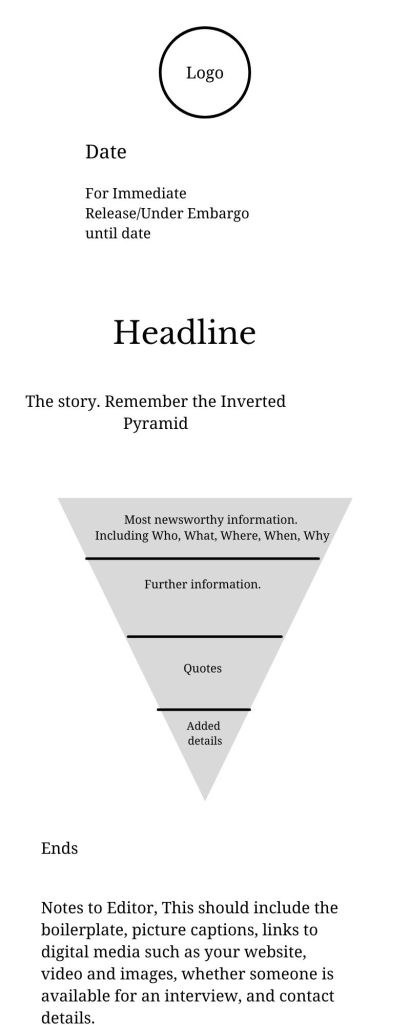
    Every press release needs Notes to the Editor after the ending. 

    This section should include:

    · A boilerplate – this is your chance to advertise your company by providing two or three sentences summarising your company’s mission and history.

    · Contact details of who is handling enquiries from the media. If the journalist needs more information, who do they contact and how.

    · Picture captions – if you have sent a photograph (and I hope you do), you need to list from left to right who is in the picture and their job title if relevant.

    · Links to images and other useful content, including your website.

    · A line telling the journalist that someone is available for interviews, photographs, filming etc.

    8. Layout.

    As a journalist and copywriter, I can write and pitch your press release to the media. For more about the world of writing, check out my Facebook and Instagram. Drop me an email at joanna@joannawoodhouse.co.uk. 

  • What qualities can a journalist bring to copywriting?

    6 Skills that make journalists effective copywriters

    When I decided to make the switch from the bustling newsroom to the world of freelance copywriting I questioned if I had the skills to do it. After all journalism and copywriting are two different disciplines. A journalist investigates and writes news and more in-depth features.  A copywriter writes to persuade a reader to take an action — whether that’s to click, make a sale, or book an appointment. But as I learnt more about the disciplines of copy and content writing I found many of my journalism skills were a good fit. And they’ve shaped the copywriting service I offer to my clients.

    What skills can a journalist bring to copywriting?

    Every news story or feature starts off with research. At the heart of every story is the interview. By asking lots of questions a journalist to tell the story will find the right angle to make the story interesting or relevant, and get insightful quotes, and provide the face to the story. I ask my clients lots of questions to ensure I get the information needed to write the content that will get them results.

    Journalists also break and back up stories by sifting through figures, reading annual reports, researching using search engines and social media, and much more. This skill can be put to good use in copywriting to get to know your business and industry, your competitors, and to understand your customers and their motivation.

    Journalists need to be able to quickly gain knowledge on topics which are new to them and turn complex subjects and jargon into writing which is easy for the reader to understand. This skill gives them an edge in producing copywriting which is engaging throughout.

    Throughout time humans have been captivated by stories, and storytelling is a powerful tool to capture your customer’s interest, engage them and help them build a connection with your brand.

    At the heart of journalism is the ability to write a good story which hooks the reader. This is a skill a journalist turned copywriter will put to good use to make your content stand out.

    To write a strong news story a journalist will pick the strongest angle, use powerful quotes, include facts and statistics, and feature human stories as case studies. They will then structure the story in a way which captures the reader’s attention and encourages them to continue reading the story.

    When it comes to producing your content, a journalist turned copywriter can put their storytelling skills to good use. Case studies, social media posts, website content, press releases, advertorials, blog posts, direct sales letters, email marketing, and newsletters are all forms of copywriting where storytelling can be effective.

    During my newsroom days I loved the rush of meeting a deadline. Among the ones I looked forward to most were A-level and GCSE results days. These days took organisation to ensure I had all the information I needed for our 9am deadline. Schools and press officers were prepped and primed for the event, and venues for photographs of happy students were set up before the summer holidays.

    Deadlines are a daily pressure for journalists. Organisation, time management, and quick-thinking, and even faster typing are key to meeting them. And these skills are vital when it comes to meeting the deadline of a copywriting project. If you have a tight deadline to meet a journalist turned copywriter will be able to work quickly to meet it.

    Every piece of work a journalist produces is pored over by editors. They criticise, ask questions, and expect rewrites to be done quickly. So, when you ask your copywriter to make changes to your copy, you can feel safe in the knowledge that after years of editors’ comments, they won’t take it personally, and they will act on it. And I know that the changes you need will mean you get the copy you want.

    KISS (Keep it Short and Simple or Keep it Short and Sweet) is one of the many acronyms in the world of marketing. The principle is that short and easy to read copy is easier to read and more likely to grab and hold the reader’s attention. Writing short and simple copy is something journalists learn in training. They use short sentences, simple words, and structure the story, so the reader finds it easy to read and doesn’t lose interest. Time and space are also reasons journalists need to learn how to keep reports short without losing impact. A reporter will learn how to edit their work to fill a space on a page or a few minutes of airtime, and still tell the story.

    Long words, jargon, lengthy sentences, and copy that doesn’t get to the point quickly will bore your reader. And the same principle applies to copywriting. By keeping it short and simple your sales copy will capture and hold the reader’s attention, which gives you a better chance of persuading them to take an action. A journalist turned copywriter has lots of experience in how to Keep it Short and Sweet.

    News stories must be well-balanced, objective, and backed up by facts. By producing honest copy and accurate copy with statistics and case studies, you will create trust with your reader. That trust means your copy is more likely to convert.

    Articles also need to be free from errors grammatical and spelling errors, names and numbers need to be correct. This means a journalist spends time proof reading and double-checking what they have written. And they will do the same for your copy.

  • Why your copywriting could be losing you customers.

    Seven tips to writing in plain English.

    “I don’t need a writer. I learnt to write essays at university, so I can do my own copywriting.”

    I heard words to this effect once when I explained my services to another business owner. It’s quite common for people to believe they can do their own copywriting because they know how to write.

    But sales copy or marketing content written in long sentences, lengthy words, and technical jargon can lose you customers. Just like those times I’ve given up on a 19th century classic novel. Because I couldn’t engage with lengthy prose and archaic language. And your prospect won’t be engaged with your message if your copy is hard to read.  

    To avoid this, you need to write in plain English. Copywriting in plain English, will win you:

    • More clicks
    • More shares
    • More sales
    • More leads
    • More website visits.

    The formula to writing in plain English.

    There are many readability formulas and apps which can help you write in plain English. Among these are the Hemingway App, Grammarly, and the Flesch-Kincaid reading score. For plain English, you need a Flesch-Kincaid score of between 60 and 70, that’s a reading age of between 11 and 13. Academic writing scores between 30 and 10.

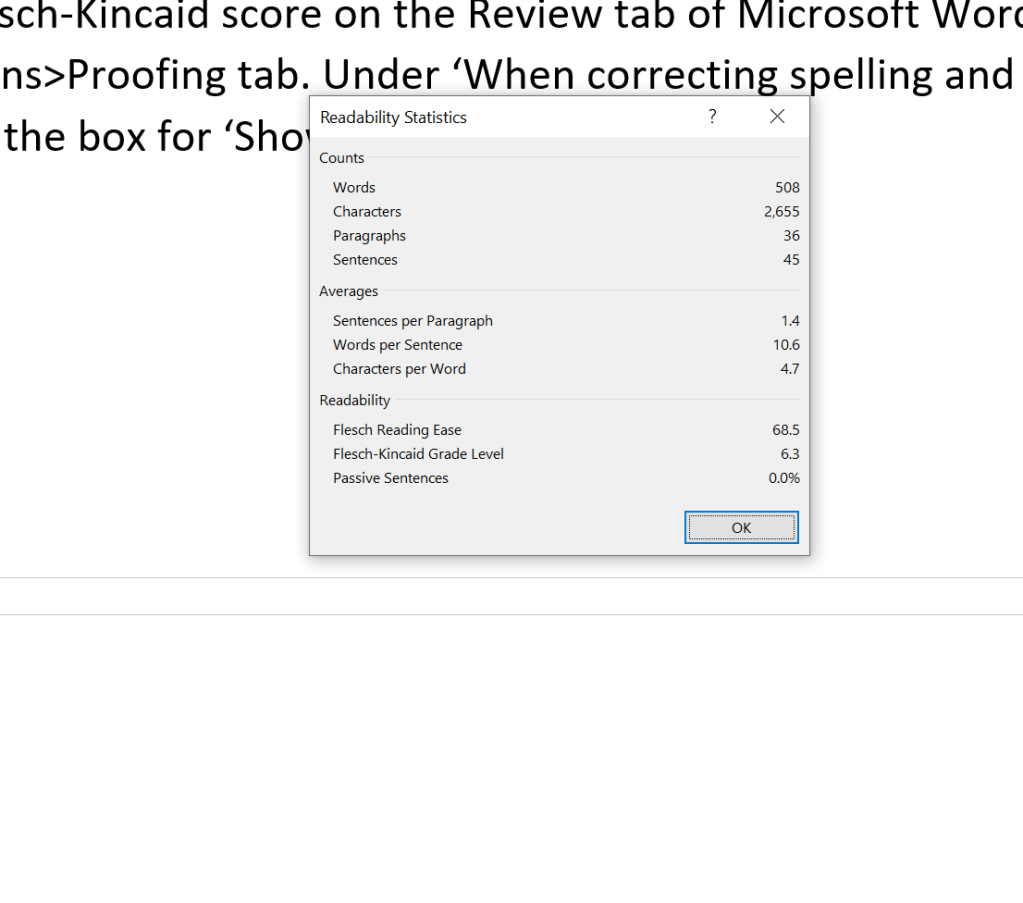
    You can check your Flesch-Kincaid score on the Review tab of Microsoft Word. Go to File Menu>Options>Proofing tab. Under ‘When correcting spelling and grammar in Word’ tick the box for ‘Show readability statistics.’ As you can see my Flesch-Kincaid score for this article was 68.5.

    Flesch-Kincaid Readability score for engaging copywriting.

    Seven secrets to achieving plain English.

    1. Write in short sentences.

    The length of your sentences should be under 25 words and use one sentence for one idea.

    2. Use short words.

    The fewer syllables your word contains the better. If you think of a long word, check there isn’t one shorter.

    3. Avoid long paragraphs.

    A paragraph should contain two to three sentences and each paragraph should make one point.

    4. Use the active voice.

    The active voice is easier to read than the passive voice, and it has more impact. The active voice is when the subject comes before the action in a sentence.

    Here’s an example: Active voice – ‘The company made 10% more profit after increasing their content marketing output.”

    Passive voice it’s: “After content marketing output was increased the company made 10% more profit.”   

    5. Get rid of jargon.

    It may look clever to use technical or legal terms, but to communicate your message needs to understand them.

    6. Don’t be long-winded.

    Why use three words when one will do? Instead of writing ‘at the present time’ choose ‘now.’

    7. Read texts written in plain English.

    Reading makes you a better writer. For inspiration for how to write in plain English read:

    • The BBC News website.
    • Newspapers and news websites.
    • Children’s books such as Harry Potter — written for children aged 9-14.

    Are you finding plain English copywriting harder than your university dissertation? Outsourcing to a copywriter will save you time and effort and will get results. Contact me at joanna@joannawoodhouse.co.uk

    Follow me on Twitter and LinkedIn for more writing tips.

  • Five ways to beat copywriter’s block

    Writer’s block can strike even the most prolific of us. Whether you’re writing a novel, an email, or a blog post, it can stop you in your tracks. What will you get those creative juices flowing again? I’ll let you into some of my tips and tricks — although some might strike you as a bit odd.

    Tips for when copywriter’s block strikes.

    This is my number one tip. Leave your screen and take a walk. Not only is walking ten minutes a day good for you, but research at Stanford University has found it boosts creativity by 60%. Some of the most famous writers who have ever lived love to walk. Charles Dickens is believed to have walked 12 miles each day. And it’s reported William Wordsworth clocked up 175,000 miles in his lifetime.

    Fresh air, exercise and a change of scenery always helps me to think more clearly. But inspiration can strike at the strangest places. So, when that killer phrase pops into your head make sure you can have something on you to record it before it vanishes forever. It could be a notebook or your phone.

    There have been times on my walk when I’ve had a brainwave. Because I don’t want to forget it, I’ve recorded a voice memo on my phone, despite some funny looks. So, make sure you have a notebook or your phone with you when you have your flash of inspiration.

    2. Get some exercise.

    What if it’s raining outside? I find a short burst of exercise can provide the same results as going for a walk. YouTube has lots of seven and 10-minute workouts which won’t get you too sweaty. I also enjoy a quick game of Just Dance or boogieing to a track on Spotify — when nobody’s watching of course.

    3. Pick up a book.

    Any escape from your screen will help cure writer’s block. I like to take 20 minutes away from my screen with my latest book. Watching television is also an escape away from your screen, but reading can make you a better writer. Reading other people’s words can be inspirational and stimulating. Just Publishing Advice has some useful tips on you can use reading to improve writing.

    4. Brainstorm.

    Sometimes I need to be productive even though the words aren’t flowing anymore. I have my screen break but take my notebook and pen with me. Writing on paper instead of on the screen helps me when writer’s block has struck. I can brainstorm sitting on my sofa, and when I return to my screen, I’ll turn those ideas into sentences.

    5. Try some writing exercises.

    When you have writer’s block the idea that you could just sit down and write might not make much sense. But as I have been writing this post, I’ve discovered there are writing exercises which inspire creativity. I’m looking forward to trying these from Victoria Fraser.

    And Copyblogger’s Writer’s Warm Up ideas are also a great way to kick off a productive day, hopefully without writer’s block getting in your way.

    Inspiration can strike at the most unusual times. For me it’s often when I’m having a shower, doing the washing up, or when I’m about to fall asleep. These tips have one thing in common — when writer’s block hits, spend some time away from your screen.

    What are your tips for curing writer’s block? Let me know by commenting below.

    For more writing tips follow me on LinkedIn.

  • Why you need copywriting that enhances your brand image

    There’s a new barber shop in town. I walked past the other day wondering if I should take my boys. It looked very trendy. But outside the door two men having a loud argument. I decided we’d stick with our usual barber’s.

    Image is important when you are trying to win new customers. The shop front of the barber shop was stylish and eye-catching. But the argument outside gave me a bad impression and I was no longer tempted to go in. And you might have a professional, fully functioning website, but the copywriting could be losing you potential sales. Your copywriting needs to engage your reader to work. Here are some of the steps you can take to achieve that.

    1. Ensure your copywriting is error free.

    Are you confident with grammar, punctuation, and spelling? Have you proofread your copy before publishing it? These mistakes can make you look like you are careless or sloppy, or that you can’t spell. And this could undermine your reader’s confidence in your business. Accurate and proofread copywriting will show you are competent and will move your reader a step closer to taking your call to action.

    • Write to capture your reader’s attention?

    Research by the Nielsen Norman Group has found 79% of people scan a website instead of reading it. Your copy needs to be structured to hold your reader’s attention.

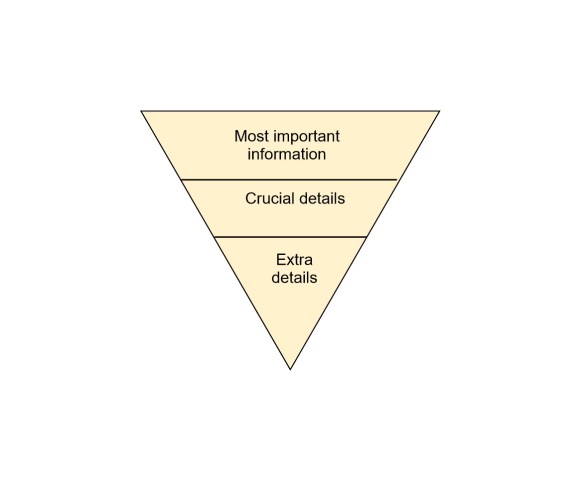
    Take a tip from journalists. They write news articles using a technique called the ‘the inverted pyramid.’ This means writing the most important facts first. This grabs the reader’s attention and encourages them to read on.

    Capture your reader’s attention with the inverted pyramid.
    • Write in Plain English.

    Is your copywriting readable? Copy with long words, lengthy sentences, and even longer paragraphs will put off your reader. Readers like text that is easy to read and to achieve this you should write in plain English. There are many apps which will check the readability of your copy. One way is by using the Readability Statistics on Word. Look out for the Flesch-Kincaid Reading Score. For plain English this should be between 60 and 70.

    Here are some other tips for copywriting that will engage:

    • Use eye-catching headings.
    • Divide your text with sub-headings.
    • Break up text with numbered or bullet lists.
    • Use short paragraphs.
    • Write sentences which are less than 20 words long.
    • Write for your ideal customer.

    Another way to engage your reader is to write specifically for them. Create a profile, or buyer persona, of your target client or customer. It should include:

    • Demographic details including gender or gender identity, age, job, income, family.
    • What they read.
    • Their preferred social media platform.
    • Favourite film of book.
    • Their goals.
    • Their challenges.

    When you have defined your customer or client, you’ll be able to write copy that will resonate with them.